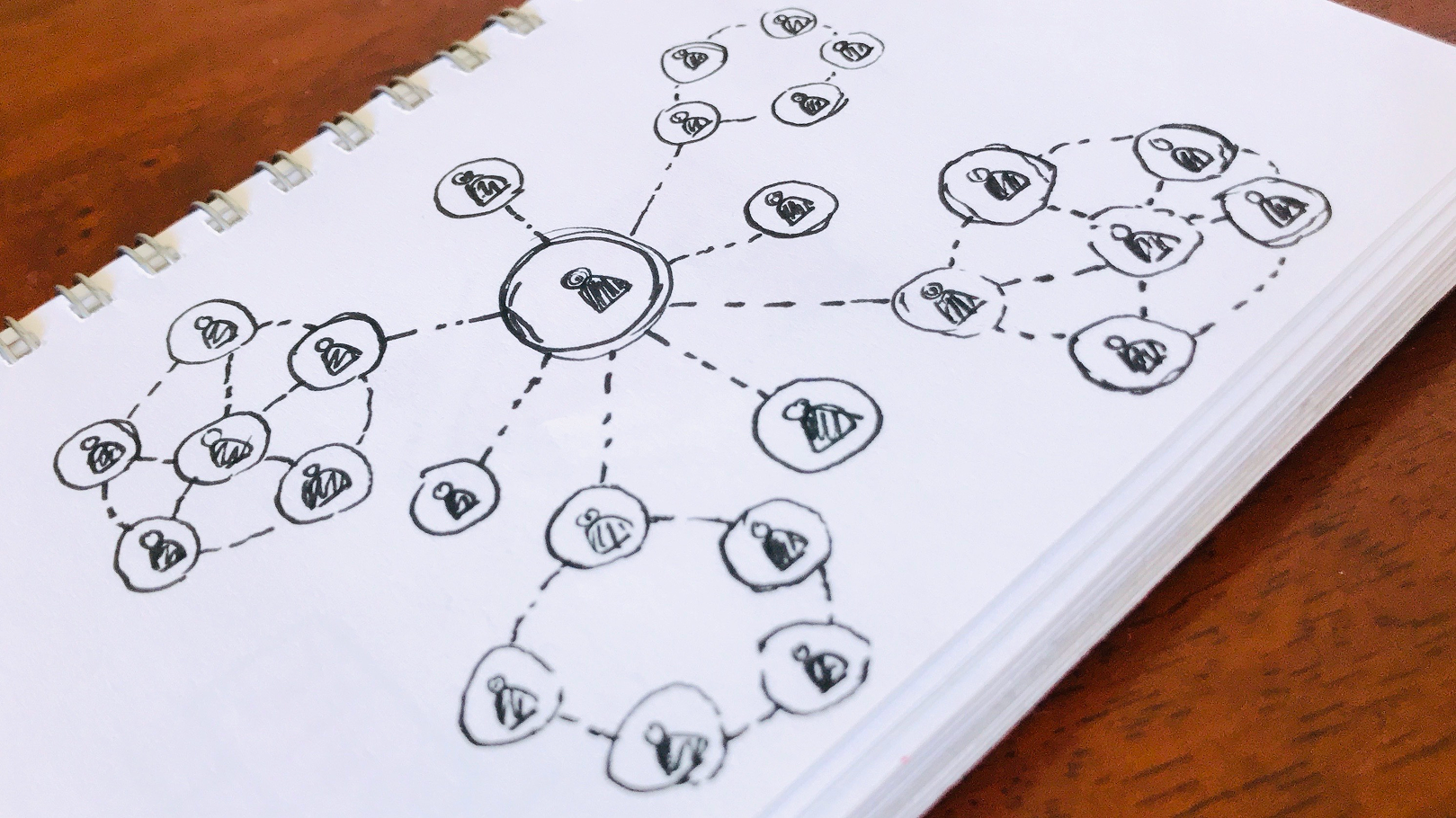
Before a company can put an AI agent to work on anything that matters, it tends to discover the same thing. The first task is not model selection or prompt design. It is writing down what nobody ever wrote down. The customer-success playbook that lives in the head of the person who has run the function for four years. The dozen unspoken rules about which contract clauses are negotiable. The reason this report is structured the way it is and not the way the template suggests. Teams reach for the agent and find that the knowledge it would need to do the job was never made explicit, because it never had to be.
The visible symptoms of this are everywhere now, and they look like tooling. Teams convert their internal documentation from PDF to Markdown so an agent can read it cleanly. They write AGENTS.md files that tell a coding agent how this particular codebase actually works. They stand up "context layers" and assemble "harnesses" and design "evals." It is easy to read all of this as a new technical discipline that arrived with the models.
It is more accurate to read it as the visible surface of a problem that is sixty years old and has never been solved: most of what an organisation knows has never been written down.
The numbers that knowledge-management researchers have used for decades make the point bluntly. Something close to ninety per cent of an organisation's knowledge is generally held to exist in tacit form — in people, not in any document or system — and tacit knowledge is usually said to account for the large majority of a firm's intellectual capital.1 By one widely cited estimate, around forty per cent of what an organisation knows how to do sits solely with individual employees, which is why the departure of a handful of experienced people can quietly remove a large fraction of what a company could previously do.2 Whatever the precise figures, the shape is not in dispute. The written-down portion of organisational knowledge is the minority, and always has been.
This was tolerable for as long as the actor doing the work was a person, because people learn the unwritten part by other means. It stops being tolerable the moment the actor is an agent. That is the argument of this piece, and it has a precise consequence: the discipline organisations now need is not new. It is knowledge management, a field that spent the better part of three decades learning its own hardest lesson — and the AI era is about to overturn that lesson in a way the field never anticipated.
A discipline that already exists
Knowledge management had its boom in the 1990s. Companies including Xerox, the World Bank and the large oil majors built formal programmes to capture what their people knew, treat it as a strategic asset, and move it around the organisation deliberately rather than by accident. The era produced a new executive title to own the problem: the Chief Knowledge Officer. Leif Edvinsson, appointed at the Swedish insurer Skandia around 1991, is usually credited as the first.3 The role spread quickly through the knowledge-intensive sectors — consulting, oil and gas, pharmaceuticals — as proof that a company took its intellectual capital seriously.
The best practical account of how this work was actually done is Chris Collison and Geoff Parcell's Learning to Fly, written out of BP's knowledge-management programme.4 Its frame is simple and durable: an organisation should learn before doing work, during it, and after it. Learning before meant the peer assist — pulling in people who had done something similar before you started, so you began with their hard-won knowledge rather than rediscovering it. Learning during meant the after-action review, a fast, blame-free check borrowed from the US Army: what was supposed to happen, what actually happened, why the difference, what do we change. Learning after meant the retrospective, a fuller review at the end of a piece of work to capture what the next team should know. Around these sat communities of practice — networks of people with shared expertise who exchanged knowledge across the organisation — and knowledge assets, which were not merely documents but packaged, reusable distillations: the guideline, the story behind it, and a pointer to the person who could explain it.
The most persuasive evidence for the value of writing things down comes from outside the corporate knowledge-management world, in medicine. In The Checklist Manifesto, the surgeon Atul Gawande argues that a large share of failure in expert work is not ignorance but lapse — the skilled practitioner who, under pressure and complexity, skips a step they know perfectly well — and that the remedy is mundane and written. Peter Pronovost's five-step checklist for inserting a central line cut one hospital's line-infection rate from around eleven per cent to near zero; the nineteen-item surgical safety checklist Gawande's team trialled across eight hospitals worldwide reduced complications and deaths by more than a third.5 What is striking is not that the checklists worked but where the resistance came from: experienced clinicians who felt the steps were beneath them. That is the tell. The value of codification is hardest to see precisely where expertise is highest, because fluency hides how much of the work runs on fallible memory. Humans did not leave things unwritten because writing them down had no value; they left them unwritten because the cost of not doing so was diffuse enough to absorb. An agent has no fluency to fall back on. For it, the checklist is not a backstop against the occasional lapse — it is the entire description of the task.
Two things are worth carrying forward from that tradition. The first is that it treated codification as a craft with its own methods, not as paperwork that practitioners would get to eventually. The second is the lesson the field learned the hard way over the following decade, which is more important than any single technique.
The lesson was that you cannot write most of it down. The philosopher Michael Polanyi had put the principle in place in 1966 with a single phrase: "we know more than we can tell."6 The skilled practitioner cannot fully articulate what makes the work good, because much of the knowledge is procedural, intuitive, and bound up in context. Nonaka and Takeuchi built a whole theory of the knowledge-creating company around the difficulty of converting tacit knowledge into explicit form and back again.7 And in 1999, in one of the most-cited pieces of management writing on the subject, Morten Hansen and colleagues drew the practical conclusion: companies face a genuine strategic choice between a codification strategy — write knowledge down, store it, make it reusable — and a personalisation strategy — accept that the knowledge is tacit, and invest instead in connecting the people who hold it to the people who need it.8 For most knowledge-intensive work, personalisation won. You did not try to document the consultant's judgement; you put the junior consultant next to the senior one.
This worked because of how people actually learn. The litigator joining a new firm does not read a manual on how the firm argues a motion; she watches two partners do it and the local method clicks into place. The apprentice learns at the elbow of the expert. Educational theorists gave this a name — situated learning, legitimate peripheral participation9 — but every organisation already ran on it. The unwritten ninety per cent transferred through watching, asking, overhearing, and being quietly corrected.
There is even a reason rooted in how minds work that organisations under-document by default. Human memory is sharply finite — the psychologist George Miller's famous estimate of "the magical number seven, plus or minus two"10 put hard limits on how much we hold in mind at once, and Hermann Ebbinghaus had shown decades earlier how steeply we forget what we do not rehearse.11 We externalise knowledge into documents and tools precisely because the head cannot hold it all. And yet organisations still wrote down only a fraction of what they knew, because the cheap social channel — watching and asking — did the rest. Codification was effortful; osmosis was free. Rational organisations chose osmosis.
The Chief Knowledge Officer, notably, did not last. The role struggled to demonstrate a measurable return, and through the 2000s it was quietly wound down or folded into the CIO's remit at many companies.12 It is tempting to read that as a verdict on codification itself. It is better read as a verdict on codification for human consumers — who had the osmosis channel anyway, which made the marginal value of writing everything down genuinely hard to prove. That qualifier turns out to matter enormously.
What changes when the actor is an agent
We argued in The Method Layer that the bottleneck to AI adoption is not the model but the method — everything between a capable system and the work that creates value inside a specific organisation. This piece is about the first move in closing that gap: codification, the act of taking what is known and writing it down so something other than the original knower can act on it. And the central fact about codification in the age of agents is that the actor has changed in a way that removes the workaround organisations have leaned on for sixty years.
Start with the agent's memory. A model's context window is, functionally, its working memory: the finite space into which the relevant information for the current task must be assembled. It is larger than Miller's seven items, but it is still bounded, and you cannot pour an organisation into it. So the question codification has to answer for an agent is exactly the question knowledge management always asked — what is the right knowledge, in the right form, available at the right moment — only now with the tolerances tightened and the margin for informality gone.
Then the decisive break. An agent cannot learn the unwritten part the way a person does. It cannot sit at the partner's elbow. It cannot watch two colleagues and infer the local bar. It cannot be "connected to an expert" in any sense that lets it absorb tacit knowledge through participation, because it does not participate; it is invoked. The personalisation strategy — the one knowledge management spent two decades concluding was the smarter answer for tacit work — is simply unavailable when the consumer of the knowledge is a model. Connection assumed a learner who could absorb. The agent is not that learner.
This is the inversion. The AI era does not let organisations skip codification. It removes the option they had been using instead of codification. For sixty years the unwritten ninety per cent was fine, because the people doing the work were the people who needed it and they could pick it up by other means. Agents end that arrangement. Every piece of method that used to transfer by osmosis now has to be made explicit, up front, in a form a machine can read — because there is no longer a learner on the other side who can fill the gaps. The codification organisations once treated as optional housekeeping becomes the ground the work stands on — and doing it well becomes a craft in its own right.
This is why the new vocabulary maps so cleanly onto the old. Context is the assembled knowledge the agent needs for the step. A harness is the runbook and the escalation path. An eval is the "this is what good looks like" review made repeatable. AGENTS.md is the onboarding note you never wrote for the new hire because the new hire could just ask. These are not five inventions of the model era; they are knowledge assets, runbooks, and quality reviews rebuilt for a reader who cannot fill the gaps.13 Joe DosSantos, who runs enterprise data at Workday, put the shift in one line: "Documentation is for humans. Agents need infrastructure they can read at inference time."14 Codification used to target a human reader who could supply what was missing. It now targets one who cannot.
The honest qualifier is that this does not abolish Polanyi's problem; it inherits it. Codification was always lossy — you still cannot fully write down what you cannot tell — and it is lossy for agents too. An agent given a codified rule without the reasoning behind it will apply it correctly in the centre of the distribution and fail at the edges, which is exactly where tacit judgement used to do its quiet work. The frontier the industry is now pushing on — persistent agent memory, continual learning — is best understood as an attempt to rebuild the osmosis channel for machines, to let an agent accumulate the unwritten part from experience rather than receive all of it as specification. It is early, and it is not a reason to defer the codification work. It is the reason the codification work is hard rather than impossible.
The companies betting on the gap
The clearest evidence that this is a real and commercial problem is that a category of company has formed around it, splitting along a familiar line.
On the horizontal side are the companies selling the knowledge infrastructure itself — the attempt to make an organisation's existing knowledge legible to agents in general. Atlan builds an enterprise "context layer" and packages knowledge as versioned, tested, governed "context products," which is the Learning to Fly knowledge asset reborn as a maintained, machine-readable artefact rather than a document that rots in a wiki.15 DataHub, which publishes a regular state-of-context report, frames the failure mode precisely as agents lacking the organisational knowledge that humans carry in their heads and have never systematised — Polanyi, restated by a vendor. Its report records the gap that the whole category exists to close: a large majority of enterprises claim their context is operational, while a majority of those same firms still delay AI projects because the knowledge is not trustworthy in practice.16 Dust takes the connection idea and rebuilds it for a world that includes agents, giving humans and agents a shared layer of context and memory across the sprawl of Slack, Notion, Drive and the rest.17
On the vertical side are the companies that do not sell knowledge infrastructure at all but a finished product that only works because a specific domain's method has been codified into it. Klarity is a clean example: it automates revenue-accounting and contract review by extracting terms from contracts and invoices into audit-ready checklists, validating each field against the company's own rules, scoring its confidence, and routing the uncertain cases to a human.18 Everything that makes that product work is codified accounting method — what to look for, what "correct" means, when to escalate. It is the same move Harvey makes when it hires lawyers as Legal Engineers, pointed at a different domain. The horizontal players are trying to codify the general; the vertical players have codified the particular and sell the result.
The codifier, and the ghost of the CKO
The codification work also shows up where Applied Methods watches most closely — in who companies are hiring. Across the 9,806 active roles at the 122 companies we track, the titles that signal method-extraction are not marginal. Forward Deployed Engineer appears in 203 postings and Solutions Architect in 298; Applied AI titles add another 83. These are, in large part, the roles whose job is to get inside a customer's environment, learn how the work is actually done, and encode it so the product can run against it.
Two patterns have sharpened since we last looked. The first is specialisation. Legal Engineer — the title that put a JD and several years of practice behind a word that contains "engineer" — now appears in 43 active roles, still concentrated almost entirely at Harvey and Legora. But Legora has begun splitting the title into sub-disciplines: Legal Engineer for law firms, for in-house teams, for tax and audit, alongside a Lead Legal Engineer above them. A title specialising into a hierarchy is what a discipline looks like when it is settling in rather than passing through.
The second pattern is spread. The "Deployment Engineer" formulation has propagated well beyond its Palantir origins: OpenAI runs dozens of AI Deployment Engineer roles across products and regions, and the same shape appears at Databricks, Nscale, Writer and Figure AI. It has even reached the physical world, where the knowledge being codified is not a document but a movement — Figure AI hires deployment engineers for commercial robot sites, and Sunday Robotics advertises a "Memory Developer," a title that on inspection is a codification role: capturing how a physical task is done so a robot can repeat it. The codifier is not a single hot job title. It is a function that keeps appearing under whatever word a given industry already trusts.
This is where the Chief Knowledge Officer earns a second mention, as a caution rather than a precedent. The 1990s also produced a wave of roles dedicated to capturing and circulating organisational knowledge, and most of them did not survive, because the value was real but diffuse and the return was hard to prove. It is entirely possible that "context engineer," "Legal Engineer" and "Memory Developer" are this cycle's CKOs — titles that flare up while the problem is fashionable and fade once the tooling absorbs the work or the budget tightens.
The reason it might be different this time is the one thing the comparison with the CKO actually turns on: the consumer of the codified knowledge has changed. The CKO was trying to persuade humans to reuse knowledge they could already obtain by asking a colleague, which is why the marginal value was so hard to demonstrate. The codifier today produces the only input the agent can use at all. There is no colleague to ask, no partner to watch. That gives the work a harder economic floor than knowledge management ever had — not because codification suddenly became easy to value, but because the alternative to it disappeared. Whether that floor holds is a genuinely open question, and worth watching in the hiring data rather than asserting.
Rewriting the practices for a reader who cannot fill the gaps
If the discipline organisations need is an old one, the most useful thing is not to reinvent it but to take its best practices and rewrite each for an actor who learns nothing by watching. The Learning to Fly repertoire survives the translation surprisingly well; what changes is instructive in each case.
-
The peer assist becomes just-in-time context. Learning before, for a human, was a meeting with people who had done it. For an agent it is a versioned context artefact retrieved at the relevant step — the "ask someone who has done this" turned into a standing asset the harness fetches when it is needed. The peer the agent draws on is the codified method itself.
-
The after-action review splits in two. A human team could only afford to review at milestones, because attention is scarce. An agent emits a complete trace of what it did, so the data side of the review can run continuously and automatically. But the judgement side — why was there a difference, what should change — is precisely the tacit evaluation a human still has to supply. The review does not disappear; it becomes high-frequency on data and low-frequency on judgement.
-
The retrospect becomes operational rather than archival. Collison's retrospect produced a report a future team might read. For an agent, the output of the review wires directly back into the context the next run consumes, so the loop closes mechanically instead of depending on someone remembering the lesson. The learning-after artefact stops being a document and becomes part of the running system.
-
Communities of practice gain agents as members and lose practitioners as authors. The old community circulated tacit tips between experts. The new one propagates a single canonical method instantly to every agent instance — which solves knowledge management's perennial problem of getting knowledge to flow, and replaces it with a new one: curation and freshness. The human members shift from practising the method to stewarding it. Someone has to own the artefact, or it rots.
-
Knowledge assets become context products, and the rationale matters more, not less. Versioned, owned, governed, with a refresh cadence and a clear owner — the discipline Atlan is productising. The instructive part is that the why behind a rule, which a human could often skip because they would infer it, has to be written down for an agent, because an agent applying a rule without its reasoning fails exactly where judgement used to save it. The asset gains a machine-readable spine but keeps its narrative.
-
Self-assessment becomes continuous evaluation. The old maturity self-assessment told a community where its capability was strong and weak so learners could be routed to those ahead of them. The agent-era version is the eval, run continuously and quantitatively, and its routing purpose survives intact: send the low-confidence case to the human or the better-codified path. Klarity's confidence-scoring-and-route-to-a-reviewer is this practice, automated.
-
Connection over collection — inverted, then partly rebuilt. The hardest-won lesson of knowledge management was to stop trying to write it all down and connect people instead. For agents that lesson is reversed: collection is forced, because connection is unavailable. The synthesis is not "codify everything forever." It is "codify what you must now, while the connection channel for agents — memory, continual learning — is still being built." The aim is to write down what the agent cannot yet learn for itself, and no more.
None of these is exotic. Each is a practice that worked for human organisations, adjusted for a reader who arrives with no context and absorbs nothing informally. Taken together they are not a list of tips so much as the beginnings of a method — which is the point. The next thing a serious organisation does with practices like these is codify them: turn them into a playbook that an actor, human or otherwise, can run against. An article about codification whose own conclusions want to be codified is not an accident. It is the loop doing what the loop does.
For sixty years, organisations got away with leaving most of what they knew unwritten, because the people doing the work were the ones who needed it, and they could watch, ask, and absorb the rest. Agents take that away. They cannot be connected to an expert; they can only be given what has been written down. Knowledge management's smartest move was to stop writing things down and connect people instead. The agent era's first move is the reverse: to treat codification as the craft it always was, and to write things down in earnest — deliberately, one method at a time.
References
-
Tacit-knowledge share. Estimates vary and are widely repeated across the knowledge-management literature; see e.g. STRIVR, "Why Institutional Knowledge Puts Your Business at Risk" (≈90% of organisational knowledge held in tacit form), https://www.strivr.com/blog/solving-the-institutional-knowledge-gap; and ClearPeople, "Capturing Tacit Knowledge" (tacit knowledge as the majority of intellectual capital), https://www.clearpeople.com/blog/capturing-tacit-knowledge-in-organizations. ↩
-
Roughly 40% of institutional knowledge held solely by individual employees — Mem, "Capture and Codify Institutional Knowledge," https://get.mem.ai/blog/how-t0-capture-institutional-knowledge. ↩
-
On the Chief Knowledge Officer and Leif Edvinsson at Skandia (c. 1991): "Chief knowledge officer," Wikipedia, https://en.wikipedia.org/wiki/Chief_knowledge_officer; and "Knowledge Management History," Bloomfire, https://bloomfire.com/blog/knowledge-management-history/. ↩
-
Chris Collison & Geoff Parcell, Learning to Fly: Practical Knowledge Management from Leading and Learning Organizations (Capstone/Wiley), https://books.google.com/books/about/Learning_to_Fly_with_free_online_content.html?id=MymRCgAAQBAJ. ↩
-
Atul Gawande, The Checklist Manifesto: How to Get Things Right (Metropolitan Books, 2009), https://atulgawande.com/book/the-checklist-manifesto/. On the surgical-checklist results across eight hospitals, see Harvard T.H. Chan School of Public Health, "A simple checklist that saves lives," https://hsph.harvard.edu/news/fall08checklist/; the WHO Safe Surgery Saves Lives findings were published as Haynes et al., New England Journal of Medicine (Jan 2009). ↩
-
Michael Polanyi, The Tacit Dimension (1966) — the source of the phrase "we know more than we can tell." ↩
-
Ikujiro Nonaka, "The Knowledge-Creating Company," Harvard Business Review (Nov–Dec 1991), https://hbr.org/1991/11/the-knowledge-creating-company-2; developed in Nonaka & Hirotaka Takeuchi, The Knowledge-Creating Company (Oxford University Press, 1995). ↩
-
Morten T. Hansen, Nitin Nohria & Thomas Tierney, "What's Your Strategy for Managing Knowledge?", Harvard Business Review (Mar–Apr 1999), https://hbr.org/1999/03/whats-your-strategy-for-managing-knowledge. ↩
-
Jean Lave & Etienne Wenger, Situated Learning: Legitimate Peripheral Participation (Cambridge University Press, 1991). ↩
-
George A. Miller, "The Magical Number Seven, Plus or Minus Two," Psychological Review 63(2) (1956): 81–97, https://labs.la.utexas.edu/gilden/files/2016/04/MagicNumberSeven-Miller1956.pdf. ↩
-
Hermann Ebbinghaus, Über das Gedächtnis (1885) — the origin of the "forgetting curve." ↩
-
On the decline of the CKO and the reassignment of knowledge-management to the CIO: "The (New) Age of Knowledge Management," CIO, https://www.cio.com/article/2443142/the--new--age-of-knowledge-management.html; and "The Demise of Knowledge Management Executive Leadership," David Publishing, http://www.davidpublisher.com/index.php/Home/Article/index?id=25670.html. ↩
-
On context engineering and agent-readiness artefacts: Anthropic, "Effective context engineering for AI agents," https://www.anthropic.com/engineering/effective-context-engineering-for-ai-agents; and on AGENTS.md, Augment Code, "How to Build Your AGENTS.md," https://www.augmentcode.com/guides/how-to-build-agents-md. ↩
-
Joe DosSantos (Workday), quoted in Atlan, "Why AI Agents Need an Enterprise Context Layer," https://atlan.com/know/why-ai-agents-need-an-enterprise-context-layer/. ↩
-
On versioned, governed "context products": Atlan, "Context Engineering Framework for Enterprise AI," https://atlan.com/know/context-engineering-framework/. ↩
-
DataHub, "The Context Layer for AI: What Enterprises Get Wrong" (State of Context Management Report 2026: ~88% claim operational context, ~61% still delay AI initiatives), https://datahub.com/blog/context-layer-for-ai/. ↩
-
On Dust (multiplayer human + agent platform; May 2026 Series B): TechPluto, "5 Under-the-Radar AI Infrastructure Companies Building the Agentic Future," https://www.techpluto.com/ai-infrastructure-companies-2026/. ↩
-
On Klarity (revenue-accounting and contract-review automation; funding): Barndoor AI, https://barndoor.ai/ai-tools/klarity/; and "Klarity Intelligence Reels in USD 70M for Document Review," AI Demand, https://www.ai-demand.com/news/tech-news/artificial-intelligence-news/klarity-intelligence-reels-in-usd-70-m-for-document-review/. ↩